
You can use this index to jump to any section of the article.
Coaching in Powerlifting is more than just programming.
Preparing a lifter for a competition requires attention to a vast amount of detail before, during and after the competition. This article aims to lay out some of the most frequently experienced elements of coaching Powerlifting and how to manage these areas effectively to provide the lifter with the best possibly opportunity for success.
Preparation phase
Programming the lifter is only one element of what should be a multi-factorial approach to supporting the athlete for optimum performance. The table below shows some further elements to consider when building towards the big day.

Table 1: A graphic of elements that the Powerlifting coach should consider when preparing a lifter for a competition.
Discussing each element of the preparation phase with the lifter will give you a better idea of how to proceed on the day and organise them effectively to produce the best results they are capable of. For example:
How was their preparation leading up to the competition?
Did they have to cut weight?
What are their goals for the competition?
How will their personality respond to the pressure of competition
These are examples which may influence attempt selection and help the coach improve the lifters focus and energy levels over a long competition.
Challenges the Powerlifting Coach may face in poor preparation are mostly due to a lack of communication between coach and lifter which can be either lifter or coach led. It is important that the coach holds the relevant information on the lifters lifestyle and weight loss leading up to the competition. This will ensure that attempt selections and warm up procedures are optimal for the individual lifter. Equally, the lifter has the responsibility to follow the coaches guidance and to provide effective feedback to ensure the coach has accurate information to base his/her decision during the competition on.
Competition Day Coaching
Once the lifter has prepared for the competition day, you have supported all of the necessary elements of the preparation phase it is essential that the competition day elements are considered.
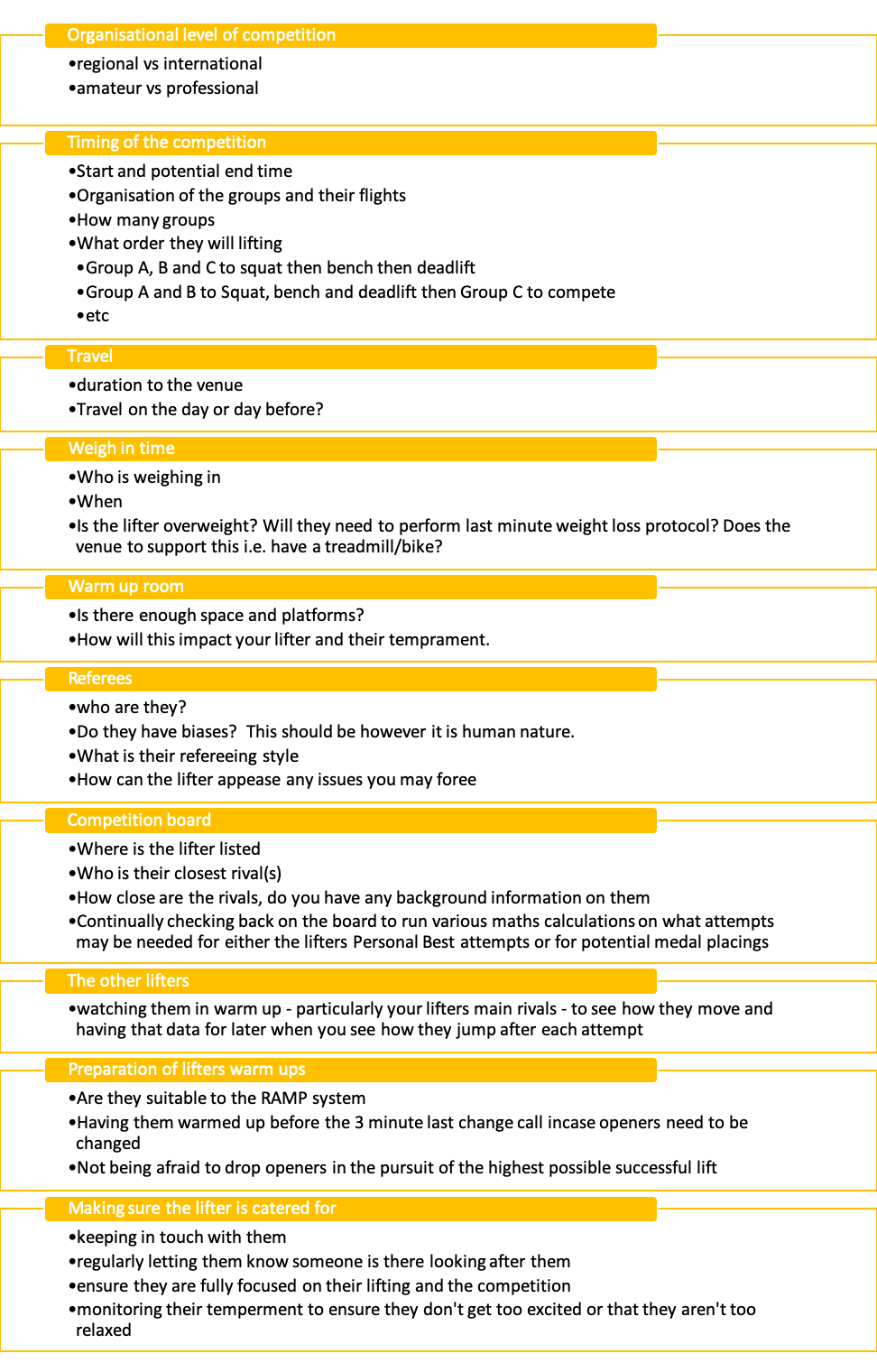
A well prepared coach will have all elements of the competition day considered to ensure they provide the best support for the lifters in the aim of achieving the lifters highest total and ranking.
Some of the most important elements, based on the supposition that the lifter is experienced and prepared well for the competition day, are to focus on the competition board and how the lifters rivals are looking on the day.
Many lifters will ‘stalk’ their rival on social media before hand, which is an idea to see how well they have looked in training or how experienced/achieved they are previously. However, as Table 2 shows, the variables that have to be managed on a day are so vast that anything could happen to anyone, so it is more prudent to be aware of how each lifter is during their warm up and on each of their attempts.
Understanding how the referees are judging lifts – depth of the squat and the pause on the bench, for example – will enable you as a coach to support your lifter far greater by ensuring any weaknesses in the lifters technique are mitigated by the weight attempts you have given them. An example of this may be a referee who prefers to have long holds on the bench, knowing this may mean you drop their weights by 2.5-5k to ensure they get 3 successful lifts. Although the other lifters may not do this, they may also suffer the consequences and fail a lift meaning a lower sub-total and more work needed from the bench press section.
Continually checking the competition board to see where your lifter ranks, where their competition is, how far away they are from each other, the amount of kilograms jumped from lift to lift for each athlete and the amount kilograms needed to achieve various goals such as individual or total medal as well as the lifters personal bests.
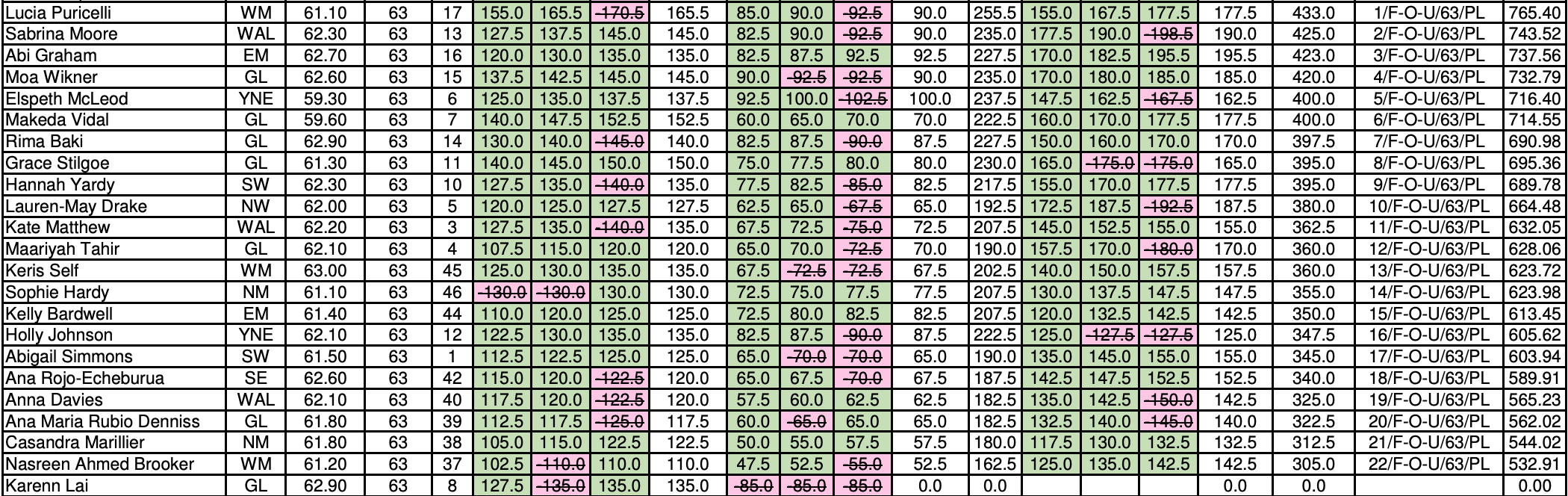
Table 3: Results from the British Powerlifting Womens Classic championships 2019
Table 3 shows a close battle at the 2019 Women’s Classic championships where only 13kg seperated the top four places. Analysing these results can identify positive and negative choices made by the coach and the overall impact that has made on the result.
Focusing on the top two lifters, the sub-totals show that Puricelli was a comfortable 20kg ahead of Moore before the deadlift section, even though she lost out on 7.5kg by failling both her third attempts on squat and bench press. However, it is well known that Moore has an extremely good Deadlift, having previously achieved over 190kg, but is also recovering from a long term achilles injury. This is relevant to Puricelli’s coach as they will utilise this information by ensuring the attempt selections are within her capabilities and building the highest possible total to keep Moore in second place. Equally, Moore missed out on her third bench press as she jumped 7.5kg from first to second then only 2.5kg to her third. There could be an argument that had she only jumped 5k from first to second she would have retained a slight more energy ready for a 5kg jump to her third attempt. Without seeing the lift, it is hard to establish a correct procedure, however, analysing the results can show the budding coach how each lift can hugely impact the end result of the competition.
An alert, prepared, organised and mathematically astute coach will best support their lifter before and during a competition and end up helping them achieve the best possible result from their competition.


 South West Strength and Conditioning