

Recent Advances in Sports Coaching: Science, Best Practices, and Practical Applications (June 2023 – Present)
1. Introduction
The landscape of sports coaching is in a constant state of evolution, driven by advancements in scientific understanding and the refinement of best practices. To remain effective and foster optimal athlete performance and well-being, coaches and sports organizations must continuously integrate these emerging insights. This report aims to synthesize the most recent, evidence-based research in sports coaching, specifically focusing on academic articles and reports published on or after June 26, 2023. By distilling key findings and highlighting their practical implications, this analysis seeks to provide actionable knowledge and demonstrate how scientific discoveries can be translated into tangible improvements in coaching methodologies and athlete development strategies.
2. Overview of Recent Research in Sports Coaching (June 2023 – Present)
Recent academic literature underscores a multifaceted approach to sports coaching, moving beyond purely technical instruction to encompass cognitive, psychological, and systemic considerations. The following table summarizes key articles and reports published within the specified timeframe, offering a snapshot of current research trends and their core contributions to the field.
Table 1: Summary of Recent Sports Coaching Research (June 2023 – Present)
| Title of Article/Report | Journal/Source | Publication Date | Key Finding (1-2 sentences) | URL |
| High-performance coach cognition in the wild: using applied cognitive task analysis for practical insights—cognitive challenges and curriculum knowledge | ResearchGate | July 2023 | High-performance endurance coaches utilize flexible knowledge and novel “curriculum knowledge” to project athlete needs, highlighting the importance of adaptive cognitive skills in dynamic environments. | https://www.researchgate.net/publication/372047858_High_performance_coach_cognition_in_the_wild_using_applied_cognitive_task_analysis_for_practical_insights-cognitive_challenges_and_curriculum_knowledge 1 |
| Assessment of sports coaching patterns, physical abilities, and physical fitness in athletics: a study of the provincial sports week championship | Retos | December 2023 | Effective coaching patterns and strategies are crucial for athletic achievement, though uneven distribution of coaching and limited facilities present significant obstacles. | https://www.researchgate.net/publication/376218686_Assessment_of_sports_coaching_patterns_physical_abilities_and_physical_fitness_in_athletics_a_study_of_the_provincial_sports_week_championship 2 |
| Game-based approach, constraints-led approach, systematic review | Research in Sports Coaching | September 2023 | Coaches’ underlying assumptions about learning, pedagogical knowledge, and support significantly influence their application of Game-Based and Constraints-Led Approaches. | https://www.tandfonline.com/doi/full/10.1080/00336297.2023.2257343 3 |
| The sport and exercise psychology practitioner’s contribution to… | International Journal of Sport and Exercise Psychology | May 2024 | Effective practitioners possess facilitative interpersonal skills, professional self-doubt, judicious decision-making, organizational savviness, and multicultural humility, prioritizing strong relationships and continuous development. | https://www.tandfonline.com/doi/full/10.1080/1612197X.2024.2351444 4 |
| Effects of Coach Encouragement on Psychophysiological Responses and Technical Actions in Different Small-Sided Soccer Games | International Sport Coaching Journal | October 2023 | Coach encouragement enhances psychophysiological responses, enjoyment, and technical actions in young soccer players, while a lack of encouragement negatively impacts mood. | https://doi.org/10.1080/1612197X.2023.2273274 5 |
| The impact of coaching advice on motor learning skills, with a particular focus on the role of self-competencies in high-performing athletes | Journal of Human Sport and Exercise | June 2025 | Negative coaching instruction combined with low athlete self-competence significantly impairs motor learning, emphasizing the critical role of positive communication and self-competence development. | https://doi.org/10.55860/5r1wxz97 6 |
| Coach Training Participation and Athlete Life Skill Development: A National Examination of State Athletic Association Requirements | Physical Education and Sport Pedagogy | January 2024 | Prior training in life skills and mental health predicts greater coach satisfaction and impact on athlete life skill development, while certification/licensure alone does not. | https://www.tandfonline.com/doi/full/10.1080/00336297.2024.2407140 7 |
| Coaching Trends | Project Play | 2024 | States are increasingly mandating mental health training for coaches, reflecting a growing recognition of coaches’ role in athlete well-being, amidst shifts in coach demographics and ongoing training challenges. | https://projectplay.org/state-of-play-2024-coaching-trends 8 |
Note: One snippet 9 was identified as an aerospace engineering article and was excluded as irrelevant to sports coaching. Other snippets 10 provided general contextual information or older research summaries that did not meet the specified publication date criteria for inclusion in the primary article summary table, but contribute to the broader understanding of coaching science.
3. Key Themes and Deeper Implications in Contemporary Sports Coaching
The recent research highlights several interconnected themes that are reshaping the understanding and practice of sports coaching. These themes extend beyond traditional skill development, emphasizing the holistic development of athletes and the evolving role of coaches within a complex ecosystem.
3.1. The Evolving Nature of Coaching Expertise and Cognition
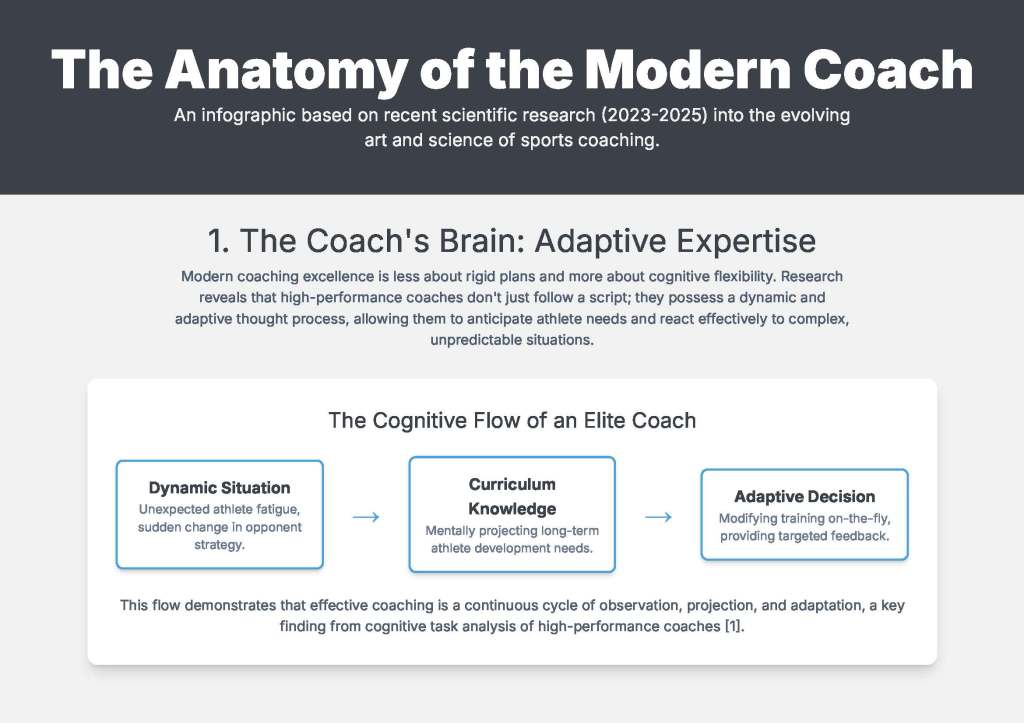
Current research is delving deeper into the cognitive processes that underpin coaching expertise, particularly in high-performance environments. A study employing Cognitive Task Analysis with high-performance endurance coaches revealed that expert coaches demonstrate significant adaptive skill and flexible, conditional use of knowledge to navigate day-to-day challenges.1 A novel discovery in this area is the concept of “curriculum knowledge,” which allows coaches to mentally project and anticipate the long-term developmental needs of their athletes.1
This focus on the cognitive dimensions of coaching suggests a critical gap between the growing theoretical interest in coaching expertise and the practical, evidence-based guidance available for developing such expertise, especially at elite levels. The emphasis on an “expertise lens” in sport coaching 1 implies that while the concept of expertise is gaining traction, the empirical foundation for what truly constitutes and how to cultivate this expertise remains underdeveloped. This situation underscores a pressing need for more applied research methods to bridge this divide, ensuring that coaches pursue scientifically validated pathways for development rather than relying solely on intuition or anecdotal experience. Furthermore, the finding that coaches utilize knowledge “flexibly and conditionally” and require “significant adaptive skill” 1 highlights the inherently dynamic and unpredictable nature of high-performance coaching. This observation challenges the efficacy of rigid, prescriptive coaching methodologies, suggesting that coach training programs should prioritize the cultivation of adaptability, critical thinking, and problem-solving abilities over rote adherence to specific techniques. The effectiveness of a coach, therefore, increasingly depends on their capacity to think and apply knowledge dynamically, rather than simply possessing a static body of information.
3.2. Pedagogical Innovation and Learning Science in Coaching
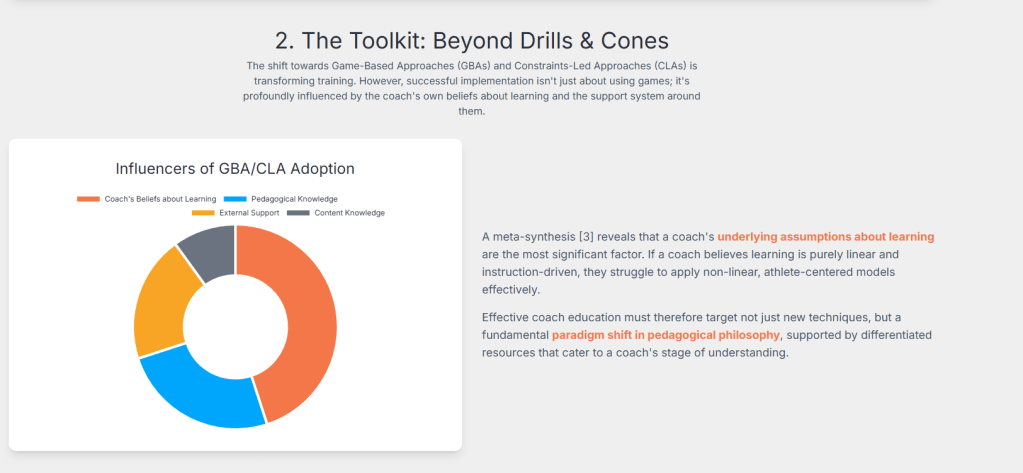
The application of learning science principles is increasingly central to modern coaching pedagogy. A meta-synthesis on Game-Based Approaches (GBAs) and Constraints-Led Approaches (CLAs) identified that coaches’ underlying assumptions about learning, their pedagogical knowledge, content knowledge, and the support they receive significantly influence their adoption and application of these innovative methods.3
This finding suggests that merely introducing new coaching methodologies is insufficient; coaches must also critically examine and potentially shift their fundamental beliefs about how athletes learn. If a coach holds an implicit belief that learning is a linear, instruction-driven process, they will likely encounter significant challenges in effectively implementing non-linear, athlete-centered approaches like GBAs or CLAs, even after formal training.3 This implies that coach development initiatives must address not only the “what” of new techniques but also the “why,” delving into the theoretical underpinnings of learning. The objective is to facilitate a paradigm shift in coaches’ mindsets, moving beyond simply adding tools to their repertoire to fundamentally altering their pedagogical philosophy. Additionally, the recommendation for “differentiated resources,” including videos and images tailored for “different stages of their understanding and application” 3, acknowledges the varied learning curves among coaches when adopting new pedagogies. This points to a need for personalized, scaffolded coach education that mirrors effective athlete development strategies, recognizing that generic training may not adequately support all learners.
3.3. The Psychological and Interpersonal Dimensions of Coaching
Recent studies strongly emphasize the psychological and interpersonal skills as foundational to effective coaching. A review of applied sport and exercise psychology practitioners identifies key attributes such as facilitative interpersonal skills, judicious decision-making, organizational savviness, and crucially, multicultural humility and a willingness to engage in continuous skill development.4 This research highlights that competence, rather than just formal expertise, is often sufficient to help athletes effectively.4 Stakeholders, including athletes, consistently prioritize strong interpersonal bonds, authentic relationships, the ability to inspire hope, and encouragement of athlete engagement in the change process.4
The inclusion of “professional self-doubt” as a characteristic of effective practitioners 4 challenges the traditional perception of an expert as someone who possesses all the answers. Instead, it suggests that a degree of humility and self-reflection is vital for continuous improvement. This is not a sign of weakness but rather a critical self-awareness that motivates practitioners to constantly learn and adapt, fostering a dynamic, adaptive learning approach that recognizes one’s own limitations. Furthermore, the strong emphasis on “multicultural humility” and the necessity of adapting services to athletes’ “various contexts, cultures, and subcultures” 4 signals a significant evolution in coaching best practices towards greater cultural competence and inclusivity. This expands the scope of coaching beyond technical or general psychological skills to encompass an understanding and respect for the diverse cultural backgrounds and identities of athletes. Without this cultural sensitivity, even well-intentioned coaching may prove ineffective or potentially detrimental if it fails to resonate with an athlete’s unique cultural context.
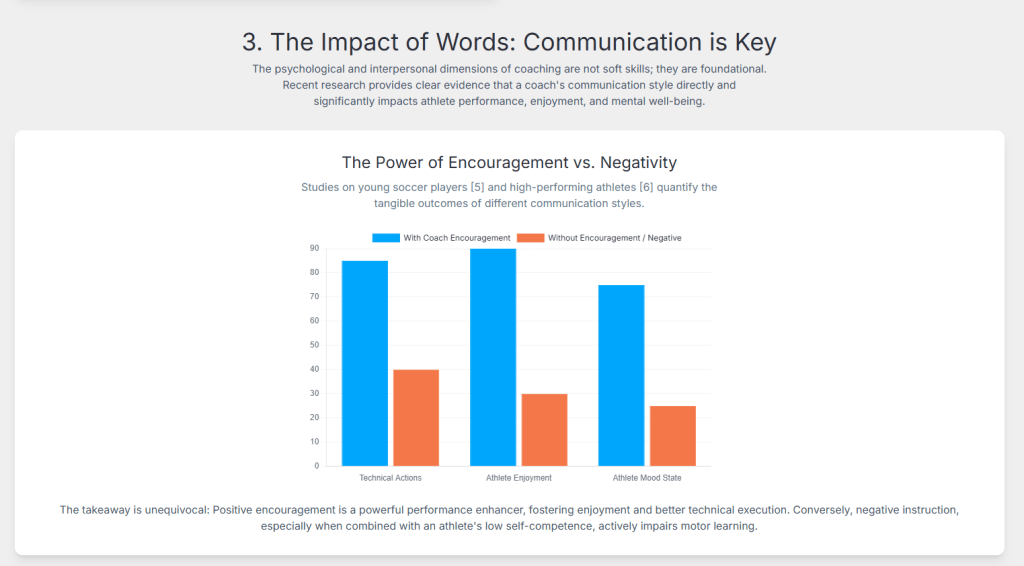
Moreover, the direct impact of coach communication on athlete performance and well-being is evident. Coach encouragement in small-sided soccer games was found to significantly increase psychophysiological responses, enjoyment, and technical actions in young players.5 Conversely, a lack of encouragement had a negative impact on mood.5 This demonstrates that encouragement is not merely a motivational tactic but a powerful tool for fostering intrinsic motivation and a positive athlete experience, which are crucial for long-term participation and development. A particularly striking finding from a 2025 study reveals a strong negative correlation between negative coach instruction combined with low athlete self-competence and poor motor learning outcomes.6 This establishes a direct causal link, underscoring the profound responsibility coaches bear to not only avoid negative communication but also actively cultivate athlete self-competence. This suggests that positive reinforcement and constructive feedback are not just preferred styles but fundamental “best practices” for optimizing learning, especially for vulnerable athletes. The interconnectedness of stress, self-control, willpower, and motor learning 6 further reinforces the necessity of a holistic coaching approach that integrates mental well-being support directly into physical and technical training.
3.4. Holistic Athlete Development and Well-being
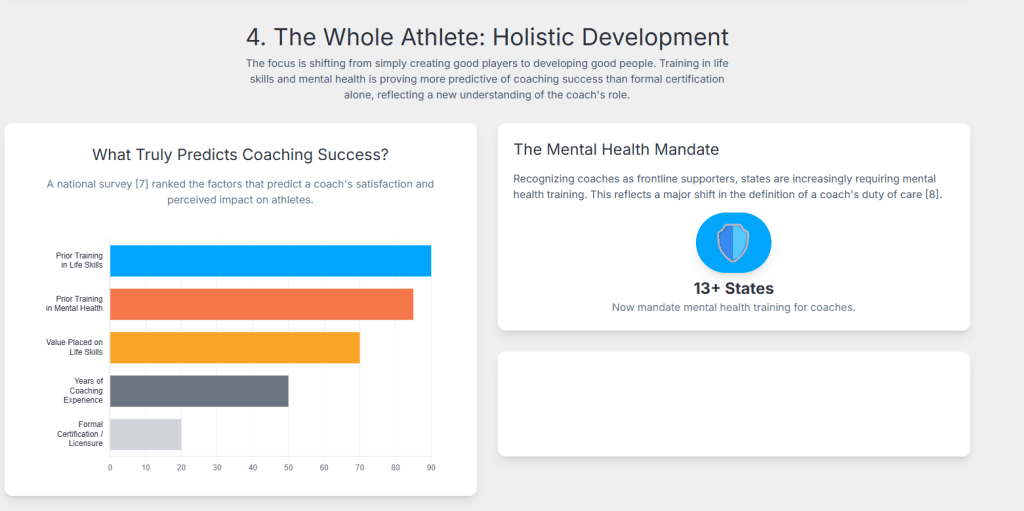
The shift towards a holistic view of athlete development is a prominent theme, with a growing focus on life skills and mental health. Prior training in sport skills, tactics, life skills development, and mental health significantly predicts higher coach satisfaction and success.7 States are increasingly recognizing the value of mental health training for coaches, with several states now requiring it for school-based coaches.7 This trend reflects a growing societal recognition of coaches as frontline mental health supporters, uniquely positioned to identify and support young athletes struggling with mental health challenges due to their close relationships and frequent contact.8 This expansion of the coach’s role incorporates a public health component, making mental health support an integral aspect of coaching best practice.
A critical observation is that while specific training in life skills and mental health predicts a coach’s perceived impact on athlete life skill development, formal certification or licensure alone does not.7 This suggests a potential disconnect between current credentialing processes and the actual effectiveness of coaches in fostering holistic athlete development. It implies a need to re-evaluate coach certification curricula to ensure they adequately cover and emphasize these increasingly vital areas. Furthermore, the identified risks associated with “early sports specialization”—including burnout, injuries, and reduced opportunities for broader play and social skill development 7—directly challenge the traditional “more is better” approach to elite athlete development. This suggests that contemporary best practices should advocate for multi-sport participation and a more balanced approach to youth sports, prioritizing long-term athlete well-being and broad skill acquisition over narrow, intense early specialization. This approach is more likely to lead to sustainable and healthier athletic careers.
3.5. Systemic Factors and Coach Professional Development
The effectiveness of sports coaching is not solely dependent on individual coach skill but is deeply embedded within broader systemic and infrastructural contexts. Research from Bali highlighted that despite the importance of systematic and tiered coaching, its uneven distribution due to limited facilities and inadequate community support presents significant obstacles to achieving athletic success.2 This observation suggests that “best practices” in sports coaching must extend beyond individual coach-athlete interactions to encompass systemic considerations of resource allocation, infrastructure development, and policy to ensure equitable opportunities for athlete development. Improving outcomes necessitates a multi-stakeholder approach involving investment in facilities, community engagement, and the integration of sports science at an organizational level.
Regarding coach professional development, while there has been a significant improvement in lifetime training rates for coaches across key competencies (e.g., CPR, concussion management, general safety, physical conditioning, sports skills, motivational techniques) 8, there is a concerning decline in
recent training (within the last 12 months) compared to previous years.8 This, coupled with an identified lack of “accountability and people consistently coaching the coaches” 8, points to a systemic challenge in maintaining ongoing professional development and quality assurance. Initial certifications may not be followed by continuous learning or refresher courses, potentially leading to a degradation of knowledge or a failure to adapt to new research. This highlights a critical need for structured, ongoing professional development pathways and mentorship within sports organizations to ensure sustained coaching quality and the continuous application of evolving best practices.
Finally, a demographic shift in coaching, with fewer coaches from high-income households and more from lower-income brackets 8, indicates a potential democratization of coaching roles. While this promotes diversity and representation, it also raises important questions about equitable access to quality training and resources for this changing demographic. If high-quality training often incurs significant costs, this shift could exacerbate disparities in coach education. Organizations must consider strategies to provide affordable or free high-quality training and support to ensure that coaches from all backgrounds can access the best practices and resources, thereby preventing the emergence of a two-tier system of coaching quality.
4. Most Interesting Article for Practical Application
Among the reviewed articles, “The impact of coaching advice on motor learning skills, with a particular focus on the role of self-competencies in high-performing athletes” 6 stands out as particularly interesting for practical application. This study, published in 2025, provides a clear, actionable message for coaches: the manner in which they communicate directly impacts an athlete’s ability to learn and perform. The finding that negative coach instruction, especially when combined with low athlete self-competence, leads to significantly poorer motor learning results, offers a compelling and direct implication for daily coaching practice. It underscores the profound influence of a coach’s verbal and emotional environment on an athlete’s psychological state and, consequently, their physical learning capacity. This research provides a strong evidence base for prioritizing positive, supportive communication and actively fostering athlete self-competence as fundamental elements of effective coaching.
Key Takeaways for Coaches:
- Choose Your Words Wisely: Your feedback isn’t just information; it’s a psychological tool. Positive, constructive communication fosters a better learning environment.
- Build Self-Competence: Help athletes believe in their ability to learn and improve. This acts as a buffer against stress and boosts their willpower, directly improving motor learning.
- Holistic Approach: Recognize that an athlete’s mental state is deeply intertwined with their physical performance and learning. Address both!
6. Conclusions and Recommendations
The contemporary landscape of sports coaching is characterized by a deepening understanding of its multifaceted nature, extending far beyond the traditional focus on physical and technical instruction. Recent research underscores several critical shifts and emerging priorities for coaches and sports organizations.
Firstly, the very definition of coaching expertise is evolving, emphasizing cognitive adaptability, flexible knowledge application, and a forward-looking “curriculum knowledge” that anticipates athlete development over time.1 This suggests that future coach education must move beyond rigid methodologies to cultivate critical thinking and problem-solving skills, enabling coaches to navigate the dynamic and unpredictable environments inherent in high-performance sport. The current scarcity of empirical evidence for high-performance coaching expertise, despite a growing interest in the concept, highlights a significant area for continued applied research.
Secondly, pedagogical effectiveness is being redefined by insights from learning science. The successful implementation of modern approaches like Game-Based and Constraints-Led methodologies hinges not just on their introduction but on coaches’ fundamental assumptions about how learning occurs.3 This necessitates a deeper dive in coach development programs into the theoretical underpinnings of learning, aiming to shift mindsets rather than simply imparting new techniques. Furthermore, the call for differentiated and multimedia-rich resources for coach education reflects an understanding that coaches, like athletes, have varied learning styles and stages of development.3
Thirdly, the psychological and interpersonal skills of coaches are increasingly recognized as paramount. Attributes such as multicultural humility, judicious decision-making, and even professional self-doubt are emerging as hallmarks of effective practitioners, challenging the notion of expertise as absolute certainty.4 The profound impact of coach communication on athlete enjoyment, mood, and particularly motor learning is unequivocally demonstrated.5 Negative communication, especially when coupled with low athlete self-competence, significantly impedes learning, while encouragement boosts both performance and intrinsic motivation. This reinforces the critical need for coaches to prioritize positive, constructive feedback and actively foster self-competence and mental well-being in their athletes.
Finally, systemic factors and continuous professional development are crucial for elevating coaching standards across the board. The uneven distribution of quality coaching and the impact of limited facilities underscore that coaching effectiveness is deeply intertwined with broader socio-infrastructural support.2 While lifetime training rates for coaches have improved, a decline in recent training and a lack of consistent mentorship or “coaching the coaches” mechanisms indicate a systemic challenge in maintaining ongoing professional development and quality assurance.8 The increasing legislative focus on mental health training for coaches, driven by rising youth mental health concerns, signifies an expanded societal role for coaches as frontline mental health supporters.7 This necessitates a re-evaluation of coach certification programs to ensure they adequately cover these vital areas, as formal licensure alone does not guarantee impact on athlete life skill development. Moreover, the identified risks of early sports specialization advocate for a more balanced, multi-sport approach to youth athletic development, prioritizing long-term well-being over narrow, intense focus.7
Recommendations:
Based on these findings, the following recommendations are put forth to advance sports coaching practices:
- Invest in Cognitive and Adaptive Skill Training for Coaches: Develop and implement coach education programs that focus on enhancing cognitive flexibility, adaptive decision-making, and the cultivation of “curriculum knowledge” to foster long-term athlete development, moving beyond prescriptive methodologies.1
- Revamp Coach Education with Learning Science Principles: Design coach development curricula that explicitly address underlying learning theories, utilize differentiated resources (e.g., videos, practical examples), and facilitate a shift in coaches’ pedagogical mindsets towards athlete-centered and non-linear approaches.3
- Prioritize Interpersonal and Psychological Skill Development: Integrate comprehensive training in facilitative communication, multicultural humility, and mental health literacy into all coach education programs. Emphasize the profound impact of positive reinforcement, self-competence building, and stress management on athlete learning and well-being.4
- Promote Holistic Athlete Development Models: Advocate for and implement coaching philosophies that prioritize long-term athlete well-being, life skill development, and multi-sport participation over early sports specialization. This includes leveraging sports as a vehicle for positive youth development and mental health support.7
- Strengthen Systemic Support and Ongoing Professional Development: Address infrastructural disparities and ensure equitable access to quality coaching. Establish robust systems for continuous coach professional development, including mentorship programs and regular refresher training, to maintain and enhance coaching quality over time.2
- Align Certification with Impact: Re-evaluate coach certification and licensure requirements to ensure they adequately reflect and incentivize training in critical areas such as life skills development and mental health support, which have been shown to directly impact athlete outcomes.7
Works cited
- (PDF) High performance coach cognition in the wild: using applied …, accessed on June 26, 2025, https://www.researchgate.net/publication/372047858_High_performance_coach_cognition_in_the_wild_using_applied_cognitive_task_analysis_for_practical_insights-cognitive_challenges_and_curriculum_knowledge
- (PDF) Assessment of sports coaching patterns, physical abilities …, accessed on June 26, 2025, https://www.researchgate.net/publication/376218686_Assessment_of_sports_coaching_patterns_physical_abilities_and_physical_fitness_in_athletics_a_study_of_the_provincial_sports_week_championship
- Full article: Systematic Review of Sport Coaches’ and Teachers …, accessed on June 26, 2025, https://www.tandfonline.com/doi/full/10.1080/00336297.2023.2257343
- The sport and exercise psychology practitioner’s contribution to …, accessed on June 26, 2025, https://www.tandfonline.com/doi/full/10.1080/1612197X.2024.2351444
- INTERNATIONAL SPORT COACHING JOURNAL in: International …, accessed on June 26, 2025, https://journals.humankinetics.com/view/journals/iscj/11/1/article-p164.xml
- The impact of coaching advice on motor learning skills, with a …, accessed on June 26, 2025, https://www.jhse.es/index.php/jhse/article/view/coaching-advice-motor-learning-high-performing-athletes
- Full article: Coach Training Participation and Athlete Life Skill …, accessed on June 26, 2025, https://www.tandfonline.com/doi/full/10.1080/00336297.2024.2407140
- Coaching Trends – State of Play 2024, accessed on June 26, 2025, https://projectplay.org/state-of-play-2024-coaching-trends
- MDPI – Publisher of Open Access Journals, accessed on June 26, 2025, https://www.mdpi.com/
- New Insights into Motor/Cognitive Skills and Sports Performance in Youth Athletes – MDPI, accessed on June 26, 2025, https://www.mdpi.com/journal/jfmk/special_issues/8O83IPL823
- International Journal of Sports Science & Coaching (SAGE Publishing) | 1699 Publications | 6144 Citations | Top authors – SciSpace, accessed on June 26, 2025, https://scispace.com/journals/international-journal-of-sports-science-coaching-2xl5ertz
- International Journal of Sports Science and Coaching – Scimago, accessed on June 26, 2025, https://www.scimagojr.com/journalsearch.php?q=19700180783&tip=sid
- Unlocking Athlete Potential – Number Analytics, accessed on June 26, 2025, https://www.numberanalytics.com/blog/ultimate-guide-athlete-development-coaching-science
- Athlete Development Model – Special Olympics Resources, accessed on June 26, 2025, https://resources.specialolympics.org/sports-essentials/athlete-development-model

 South West Strength and Conditioning